GPA Isn't the Whole Story: Why Your "Struggling" Child Might Just Need a Different Kind of Classroom
As educators, we've watched the same pattern for years: a child excels in one subject and struggles in another, and the school average turns that into a verdict. Here's why GPA hides more than it reveals — and what actually helps.
Mani Golzaridodavan
July 27, 2026
"My child isn't doing enough." "Laziness is my child's worst enemy." "They just can't stay focused."
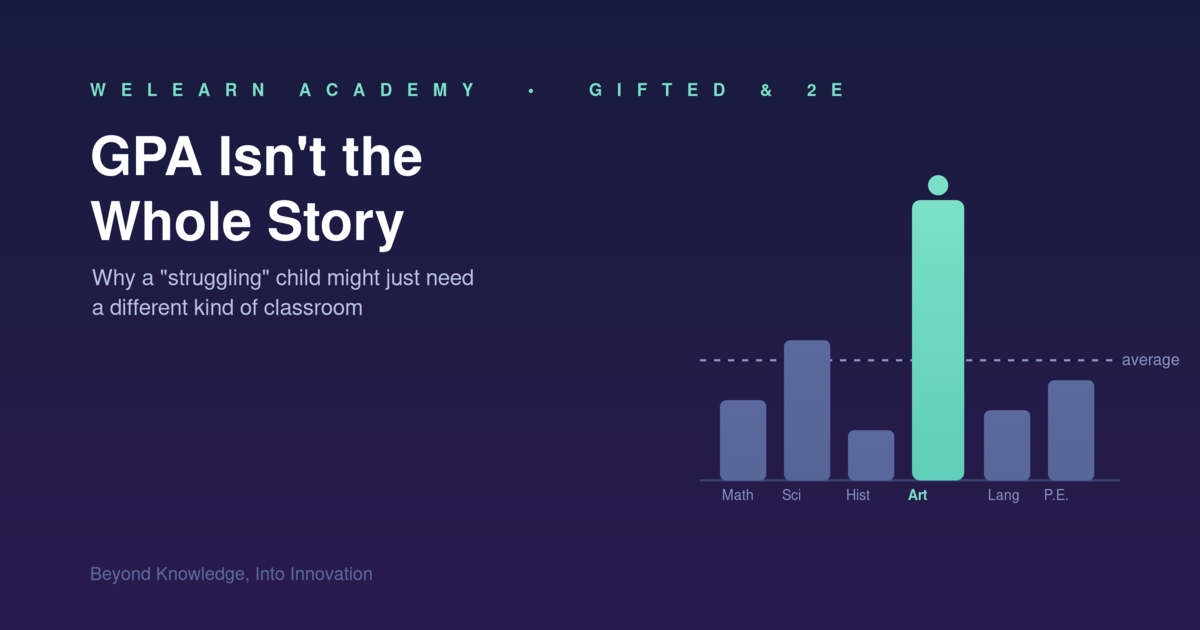
As educators, we've heard these words from worried parents for years. And time and again, we've watched the same scenario repeat itself: a child scores brilliantly in one subject and struggles in another. The school takes every grade — the highs, the lows, the in-between — and averages them into a single number: the GPA.
That number becomes a verdict. And with it comes a quiet culture of shame for not being "good enough" across the board. Parents respond in different ways — some move their child from school to school looking for the right fit, others pile on tutors and extracurriculars to close the gap. What gets lost in both approaches is the one thing that would actually help: giving the child, not the average, a chance to truly thrive.
It turns out this pattern is well documented. The Davidson Institute, a nonprofit dedicated to gifted education, recently published 8 Myths About Gifted Students Debunked, and several of the myths they unpack line up almost exactly with what parents describe to us.
Myth: A capable child should excel at everything.
As the Davidson Institute puts it: "While they may show exceptional talent in some subjects, gifted learners don't always excel universally. An individual may be great at writing, but struggle with math or vice versa." A single GPA can't capture that unevenness — it just flattens it into a number that looks like underperformance.
Myth: Bad grades mean a child isn't capable.
This is the one that drives the most anxiety at home. The article is direct about it: "Grades don't define anyone's potential, including gifted students. A person may be incredibly gifted and still struggle with grades due to a variety of reasons, such as lack of interest in the subject and anxiety." Often what looks like laziness is actually disengagement — a child who isn't being challenged, or isn't in the right learning environment, will disconnect rather than perform.
Myth: A child who can't focus is a badly behaved child.
Attention and focus don't always develop on the same timeline as intellectual ability. The Davidson Institute calls this "asynchronous development" — a child's cognitive skills, emotional regulation, and social maturity can advance at very different speeds. A child who seems unable to sit still or stay on task isn't necessarily unmotivated; they may simply need a different structure to engage with.
So what actually helps?
Not more of the same, delivered louder. The Davidson Institute's own recommendations are worth repeating: advocate for proper identification of a child's actual needs and strengths, recognize their individuality rather than measuring them against a flat average, and support their emotional and social development alongside academics — so a child learns they are "more than a grade."
This is exactly why project-based learning exists. Instead of compressing a child into one number that hides their strengths and exaggerates their weaknesses, PBL lets a child go deep where they're capable, build real skills through real work, and get support in the areas where they need it — without shame attached. It replaces the GPA culture of "not good enough" with evidence of what a child can actually do.
At WeLearn, this is the whole premise of our model. We're not trying to make every child fit the same average. We're building an environment where a child's strengths lead, their gaps get real support instead of judgment, and success is measured by what they can build, solve, and create — not by a number that never captured the whole picture in the first place.
Source: Davidson Institute, "8 Myths About Gifted Students Debunked"
Looking for a learning model built for your child?
Book a free 30-minute Discovery Call — a genuine conversation about your child's strengths and learning style.
Book a Free Discovery CallWant to learn how project-based learning can support your child? Read about our Project-Based Learning Programmes or discover WeLearn's Academic Pathways.